Haircuts for Women Over 50: Look Like Yourself, Only Better
Somewhere after fifty, a lot of women stop recognizing the person their stylist sends home. The cut that worked for years suddenly falls flat. The texture changed. The part got wider. And when you ask for something new, half the stylists out there reach for the same short, rounded, “sensible” cut, as if turning fifty came with a mandatory haircut assigned at the door.
It didn’t. What changed is your hair, not your right to a good haircut. Hair over 50 tends to run finer, drier, and less predictable than it used to, sometimes wiry where the gray comes in, sometimes thinner at the crown and temples. A great cut works with all of that instead of pretending it isn’t happening. That’s a skill, and it’s one of the things this studio does best.
The Problem Nobody Says Out Loud
Most women who land on this page are carrying some version of the same two fears. The first is the matronly haircut: the helmet, the mushroom, the cut that reads “given up” from across a parking lot. The second is the opposite: trying so hard to look young that the hair looks like a costume. As one client put it, “I don’t recognize myself in the mirror anymore… but I don’t want to look like I’m trying too hard either.”
There’s a wide, comfortable lane between those two ditches, and that’s where the right cut lives. As another woman said better than any stylist could: “I don’t want to look younger. I want to look like myself but better.” That’s the brief. That’s the whole brief.
What Makes a Cut Work After 50
There’s no single “haircut for women over 50,” and be suspicious of anyone who says there is. But the cuts that consistently work share a few mechanics:
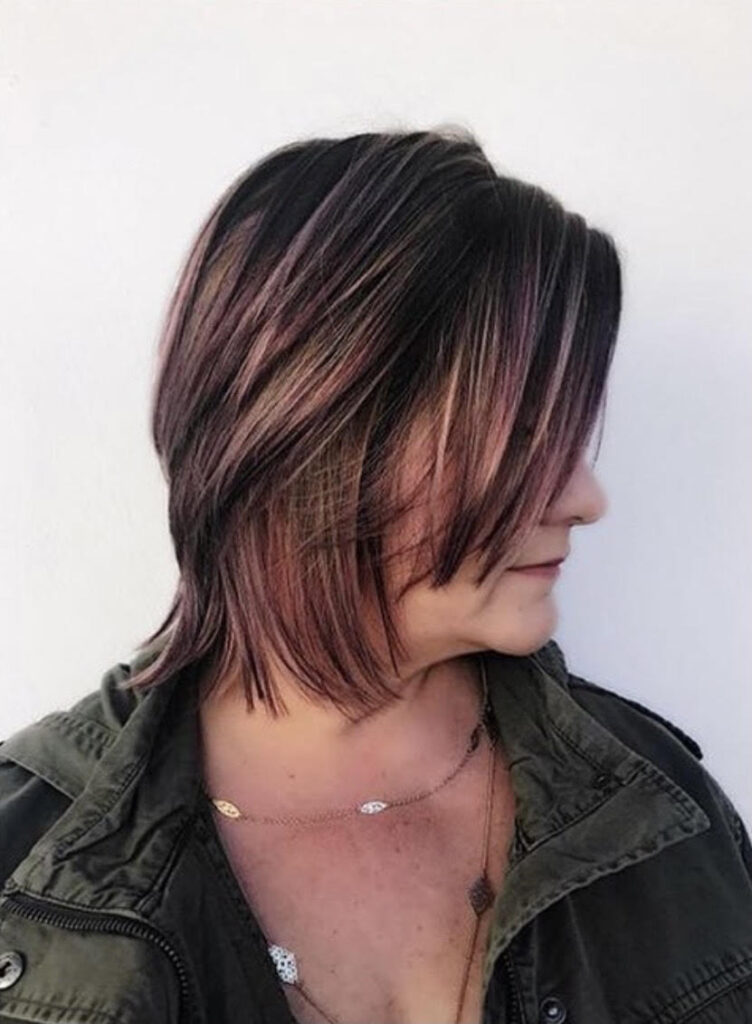
Texture beats bulk. Textured bobs and shags put movement where flat, heavy shapes just hang. When hair has thinned, removing the right weight makes what’s left look like more, not less.
Layers, placed deliberately. Layered lobs and long layers keep length while adding lift and swing. Blunt, one-length cuts can drag fine hair down; layers give it somewhere to go.
Face-framing does the flattering. Soft pieces around the face brighten it and draw the eye where you want it. It’s the least invasive change with the biggest payoff.
Volume is built into the cut. For fine or thinning hair, the cut itself should create the illusion of fullness, so you’re not fighting a round brush for twenty minutes every morning. Strategic length and interior layering do the work.
The cut and the color are one decision. Gray, blended, or colored hair each reflect light differently, and the cut should be planned around it. A textured cut makes salt and pepper look intentional and expensive; the wrong one makes it look accidental. If you’re blending or growing out gray, the cut is half the strategy.
And if you love your length: keeping it is a legitimate choice, and it won’t be treated as a negotiation. “She cut my hair while still keeping the length” is a line that turns up in local salon reviews, and it’s the rule in this chair. Nobody here will ambush you with scissors.
How It Works With Kasey
Every cut starts with a conversation in a private one-chair studio, so you can be honest about the thin spots, the cowlicks, and the photo you’re afraid to show. Kasey is Vidal Sassoon-trained, which is essentially the graduate school of precision cutting, and she’s spent years cutting fine, changing, silvering hair on real women, not mannequins.
She’ll look at your texture, your density, your growth patterns, and how much styling you’re honestly willing to do, then recommend a shape that holds up in week four, not just on blowout day. If you’re also managing gray, she’ll fold the cut into your color plan so both are pulling in the same direction. You leave with the cut plus a simple styling routine you can actually repeat at home.
What It Costs
A Designer Haircut is $100. That’s the published price for everyone; there’s no vague “prices may vary” asterisk here. If your visit pairs the cut with color or blending work, those services are priced separately and listed on the pricing page, so you can add up your total before you ever sit down.
FAQ
The one designed for your hair rather than your birth year. That said, the most consistently flattering shapes are textured bobs, shags, layered lobs, and long cuts with face-framing layers, because they add movement and lift where mature hair tends to fall flat. The consultation is where “flattering in general” becomes “flattering on you.”
No. That rule is folklore. Long hair after 50 works when it’s layered and healthy; what ages a look is shapelessness rather than length. If you want to keep your length, Kasey will build a cut that keeps it and still moves.
Usually a cut that removes strategic weight so the hair sits fuller: a textured bob, a soft shag, or layers concentrated where you’ve thinned. For more noticeable thinning, the cut can also be paired with discreet volume solutions like weft or halo-style extensions, which are worth raising at your consultation.
Significantly. Texture and face-framing make gray and salt-and-pepper hair read polished and deliberate. If you’re blending or transitioning, the cut is half the plan: it softens the grow-out and keeps the in-between stage looking styled instead of stalled.
Most shaped cuts need a refresh every 8 to 12 weeks to keep their structure, which pairs neatly with a gray-blending schedule if you’re on one. Shorter, more architectural cuts run closer to 6 to 8 weeks.
Yes. Gray often arrives with new wave or coarser texture, and the cut should use it rather than flatten it. Bring your hair the way you normally wear it so the shape gets cut for real life.
Look like yourself, only better
Cuts designed for fine, thinning, and graying hair, in a private one-chair studio.

Hair by Kasey Erokhin. A private one-chair studio for color, cuts, and gray done your way.
Serving
Rancho Bernardo · Poway
4S Ranch · Sabre Springs
Visit
Sola Salon Studios, Suite 15
12004 Carmel Mountain Road
San Diego, CA 92128
(917) 374-4878
Free parking
© 2026 The Salon 619 · Instagram